

CIMA Management Case Study | November 2026 – February 2027
CIMA MCS Wuudbreak Pre-Seen Analysis
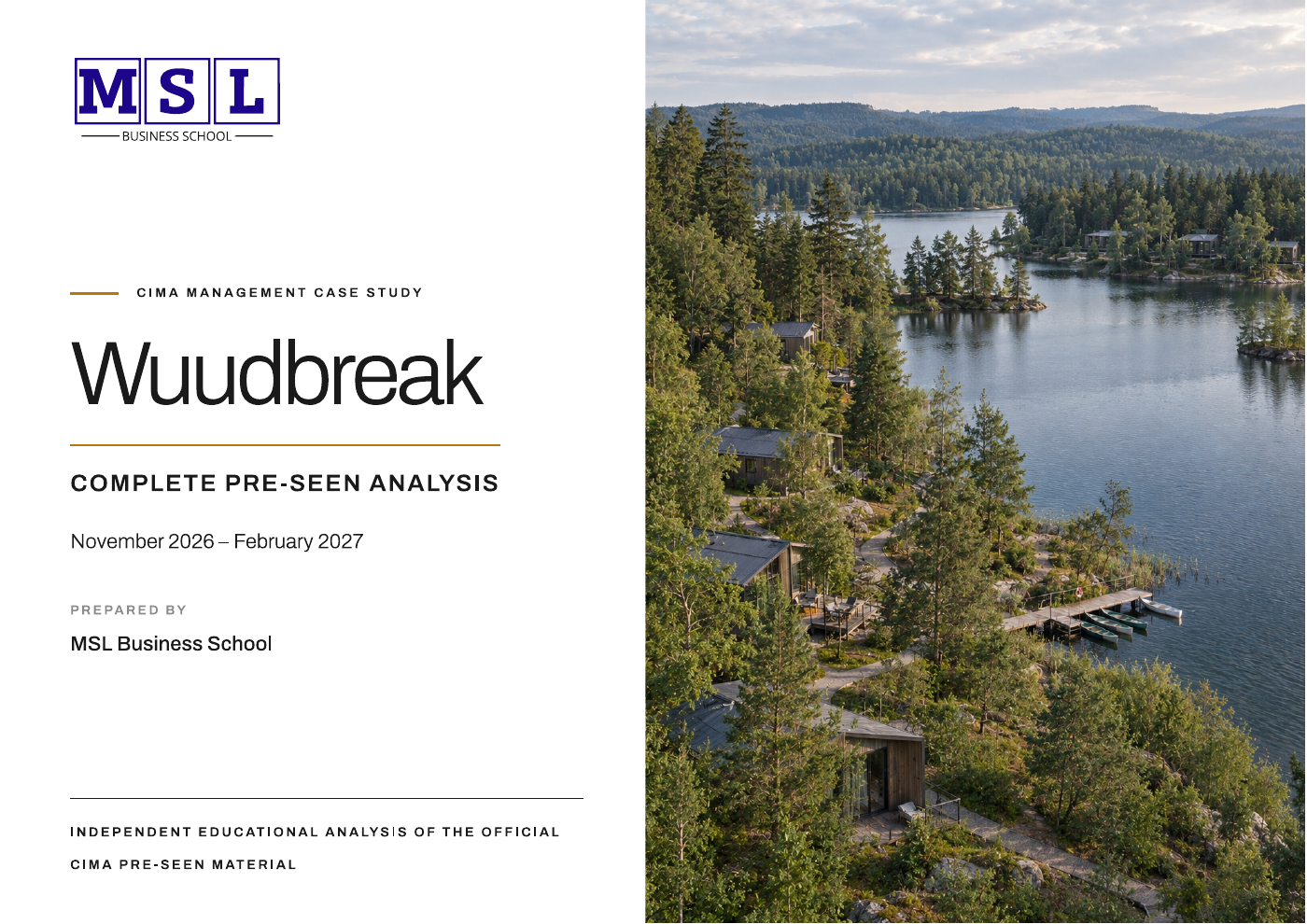
Wuudbreak is the case organisation for the CIMA Management Case Study examinations in November 2026 and February 2027.
MSL Business School has analysed the pre-seen from the perspective of the Financial Manager, covering Wuudbreak’s business model, financial performance, competitor position, sustainability, risks and the most relevant connections to E2, P2 and F2.
48-page PDF · Free download · No registration required
The company owns and operates nine upmarket holiday parks in Norrland, combining forest and lake locations with accommodation, indoor and outdoor activities, wildlife experiences, supermarkets and franchised food courts.
This page is the central MSL resource hub for the Wuudbreak case. We will continue adding free resources as preparation for the examination develops.
Case facts
Wuudbreak at a glance
Source: CIMA Management Case Study November 2026–February 2027 pre-seen. Ratios and percentage movements on this page are MSL calculations.
The organisation
What is Wuudbreak?
Wuudbreak operates nine holiday parks across Norrland.
Each park is located within a large forest and has a lake.
The locations are deliberately removed from major towns and cities while remaining within approximately 20 minutes’ drive of a motorway junction.
The parks provide relatively upmarket short activity holidays and are designed to appeal to guests across different age groups.
Accommodation ranges from studios to four-bedroom apartments.
Guests can walk, cycle, use outdoor swimming pools, participate in boating and guided activities and make use of indoor leisure facilities.
The model is deliberately self-contained.
Most guests arrive at the beginning of their stay and remain inside the park until departure.
That is commercially important because a larger proportion of the holiday can then take place within the Wuudbreak ecosystem.
Demand context
Norrland’s holiday market
Norrland is described as a relatively prosperous country whose population spends heavily on leisure.
The average person took four holidays during 2025.
Families take particularly frequent holidays.
The pre-seen divides the market into several groups.
| Customer group | All holidays | Norrland holidays | Foreign holidays |
|---|---|---|---|
| Average | 4.0 | 2.3 | 1.7 |
| Under 45, no children at home | 3.9 | 2.3 | 1.6 |
| Over 45, no children at home | 2.6 | 1.6 | 1.0 |
| Younger family | 4.1 | 2.4 | 1.7 |
| Older family | 6.3 | 3.9 | 2.4 |
Older families stand out.
They take an average of 6.3 holidays a year, including 3.9 holidays within Norrland.
That provides an attractive underlying market for a domestic family-oriented short-break operator.
Wuudbreak does not necessarily have to replace a family’s principal foreign holiday.
It can compete for the additional domestic breaks that households take throughout the year.
The proposition
What makes Wuudbreak different?
Wuudbreak is the only provider of this particular style of holiday park in Norrland.
Its proposition combines several elements:
Place
Forest and lake locations with modern accommodation.
Experience
Indoor and outdoor activities, wildlife and nature.
Audience
Family appeal and accessibility for guests with different mobility levels.
Convenience
Catering flexibility and short-break convenience.
A guest may book an apartment, but the decision to return will depend on considerably more than the accommodation.
The forest setting, activities, catering choices, staff, cleanliness and ease of moving around the park all contribute to the experience.
A weakness in any one of these areas can therefore affect how the guest judges the stay as a whole.
Alternative choices
Who does Wuudbreak compete with?
Wuudbreak has no identical competitor in Norrland, but customers have several alternative ways to spend their holiday budget.
Important alternatives include:
Foreign beach holidays
Warmer weather, attractive scenery and longer stays.
Domestic coastal breaks
Beaches, scenery and local restaurants.
City breaks
Sightseeing, culture, entertainment and convenient transport.
Caravan parks
Lower-cost accommodation, self-catering and some organised entertainment.
Couples hotels
Higher-standard short breaks aimed mainly at adults.
Wellness and spa holidays
Premium relaxation-focused experiences, often targeted at adults.
Wuudbreak therefore competes for leisure time and holiday expenditure rather than only against businesses with an identical operating model.
Location strategy
Why the locations work
Each Wuudbreak park is located at least 15 kilometres from the nearest large town or city while remaining within approximately 20 minutes’ drive of a motorway junction.
This creates a useful balance.
Guests are sufficiently removed from towns and cities to experience the quiet forest setting that forms part of the holiday, while motorway access keeps the parks practical for short domestic breaks.
The relative remoteness also reduces nearby competing attractions.
Guests are therefore more likely to spend their time, and potentially more of their holiday expenditure, inside the park.
Remote enough to feel different. Connected enough for a short break.
Forest and lake seclusion supports the experience; motorway proximity supports accessibility.
Product structure
Accommodation and customer segmentation
Wuudbreak offers accommodation ranging from studios for one or two guests to four-bedroom apartments accommodating as many as eight.
There are three grades.
Premium
Balcony and lake view.
Standard
No balcony or lake view but otherwise similar to Premium.
Value
Smaller and located slightly further from the central area.
The accommodation structure allows Wuudbreak to serve different party sizes and different willingness to pay.
Customers who place greater value on location, views or premium features can choose a higher-priced product without requiring Wuudbreak to provide every guest with the same accommodation at the same price.
Revenue management
Dynamic pricing
Wuudbreak uses dynamic pricing.
The amount charged for a booking can depend on:
- apartment size;
- apartment grade;
- time of year;
- current availability.
Prices can rise when demand is strong and few vacancies remain.
Prices may fall where vacancies are higher, particularly when the booking date is approaching.
This is commercially important because holiday accommodation is perishable capacity.
An apartment that remains empty tonight cannot be stored and sold tomorrow.
Dynamic pricing therefore helps Wuudbreak balance occupancy and revenue.
Operating rhythm
The short-break model
Wuudbreak normally offers two stay patterns.
Weekend
Friday to Monday
3 nights
Midweek
Monday to Friday
4 nights
Guests may combine the two bookings to stay for seven nights, although the pre-seen states that relatively few do so.
Concentrating departures on Monday and Friday mornings gives management predictable accommodation changeover periods.
That can improve cleaning efficiency and the use of staff.
The trade-off is reduced customer flexibility because guests cannot freely choose any arrival day or length of stay.
Revenue model
How Wuudbreak makes money
Wuudbreak has several sources of revenue.
Accommodation
Guests pay for their accommodation when they book.
Paid activities
Additional charges can arise from:
- bicycle rental;
- guided walks;
- guided cycle tours;
- boating;
- adult indoor sports.
Supermarkets
Each park has a supermarket owned and operated by Wuudbreak.
Food-court arrangements
Food outlets are operated by independent franchise principals.
Wuudbreak receives income including:
- rent;
- charges for communal facilities;
- electricity charges.
Restaurant sales themselves belong to the franchisees.
They are not Wuudbreak revenue.
That distinction is important when analysing the company’s business model and potentially when considering financial reporting questions.
Mixed pricing
What is included in the accommodation price?
- Walking on trails
- Cycling where guests bring their own bicycles
- Outdoor swimming pools
- Children’s indoor play facilities
- Bicycle rental
- Guided walks
- Guided cycling tours
- Boating
- Adult indoor sports
Wuudbreak therefore uses a mixed pricing model.
The accommodation charge provides access to a meaningful basic experience, while selected services generate additional revenue.
That also means occupancy alone does not explain the full economics of a park.
Two parks with the same occupancy could generate different revenue if guests have different levels of ancillary spending.
Payments and data
The wristband system
Guests receive wristbands when they check in.
Funds can be transferred from the guest’s bank account to the wristband and then used for:
- chargeable activities;
- supermarket purchases;
- food-court purchases.
Unused balances are refunded automatically at check-out.
Guests also receive an itemised statement showing what they purchased.
The system therefore performs two functions.
First, it provides a cashless payment mechanism inside the parks.
Second, it potentially provides Wuudbreak with detailed information about guest spending.
Potential management insight
Subject to the way the data is structured, managed and permitted to be used, management could potentially analyse:
- popular activities;
- spending by time;
- spending by guest type;
- ancillary revenue;
- congestion periods;
- product combinations.
That information could support better pricing, staffing and capacity decisions.
Human capital
Wuudbreak’s workforce
Each park employs several hundred people.
Specialist roles include:
- forestry;
- wildlife;
- guest activities;
- cleaning;
- safety;
- maintenance.
Park guides help protect natural habitats, support guests, advise on wildlife observation and provide safety guidance for boating, walking and cycling.
Wuudbreak also has many long-serving employees and low staff turnover.
Training is important, and many employees hold first-aid or other relevant qualifications.
Human capital is therefore an important part of the Wuudbreak proposition.
The business depends not only on physical assets but also on accumulated expertise, service capability, safety knowledge and environmental knowledge.
Demand and experience
Customer performance
Three figures immediately stand out in the pre-seen.
94% occupancy
This indicates very strong demand and relatively limited spare accommodation capacity.
71% repeat guests
Seventy-one per cent of guests have stayed at a Wuudbreak park at least once before.
That provides strong evidence of repeat patronage.
96% good or excellent
In 2025, 96% of guests who completed Wuudbreak’s post-stay survey rated the experience as good or excellent.
The wording matters.
The pre-seen does not disclose the survey response rate.
It would therefore be incorrect to restate this as: “96% of all Wuudbreak guests were satisfied.”
Taken together, the three measures point to strong demand, repeat business and high reported satisfaction.
Value system
Wuudbreak’s business model
Create attractive and peaceful sustainable locations where guests can relax and enjoy a wide range of activities.
Combine:
- natural resources;
- accommodation;
- employees;
- activities;
- technology;
- catering arrangements;
- environmental management.
Provide short breaks suited to guests of different ages and mobility levels.
Use:
- accommodation charges;
- dynamic pricing;
- paid activities;
- supermarket revenue;
- franchise-related income;
- efficient operating patterns.
The strength of Wuudbreak’s model lies in how these elements reinforce one another.
Its proposition would be difficult to understand properly by looking at accommodation, activities, staff or nature in isolation.
Financial analysis
Financial performance: 2025 to 2026
| N$ million | 2025 | 2026 | Change |
|---|---|---|---|
| Revenue | 807.1 | 843.7 | +4.5% |
| Gross profit | 557.0 | 601.9 | +8.1% |
| Operating profit | 341.9 | 367.9 | +7.6% |
| Profit before tax | 281.7 | 307.7 | +9.2% |
| Profit after tax | 214.1 | 233.9 | +9.2% |
Wuudbreak’s 2026 performance improved.
Revenue increased by approximately 4.5%.
Gross profit increased by approximately 8.1%.
Operating profit increased by approximately 7.6%.
Profit after tax increased by approximately 9.2%.
Profit therefore grew faster than revenue.
Margins
Profitability
| Ratio | 2025 | 2026 |
|---|---|---|
| Gross margin | 69.0% | 71.3% |
| Operating margin | 42.4% | 43.6% |
| Net margin | 26.5% | 27.7% |
| Administrative expenses / revenue | 26.7% | 27.7% |
All three major profit margins improved.
One figure nevertheless deserves attention.
Administrative expenses increased from N$215.1 million to N$234.0 million.
That is an increase of approximately 8.8%, compared with revenue growth of 4.5%.
The pre-seen does not explain why administrative expenses increased.
It would therefore be reasonable for management to investigate the movement, but not to invent a cause.
Balance sheet
Wuudbreak’s financial position
Property, plant and equipment represents approximately 88% of Wuudbreak’s total assets.
This is an asset-intensive business.
That matters because future expansion through new parks, accommodation or major facilities could require significant capital.
Liquidity improved during 2026.
The current ratio increased from approximately 0.16 → 0.29 and cash increased from N$45.8m → N$93.3m.
The current ratio remains low by conventional standards, but that alone does not establish financial distress.
Wuudbreak receives accommodation payments at the time of booking and remains profitable.
A fuller conclusion would require additional cash-flow information.
Key ratios
Liquidity, gearing and returns
Current ratio
2025: 0.16
2026: 0.29
Working capital
2025: N$(348.0)m
2026: N$(290.2)m
Debt/equity
2025: 54.4%
2026: 50.0%
Interest cover
2025: 5.7x
2026: 6.1x
Approximate ROCE
2025: 12.0%
2026: 12.2%
ROCE calculated using year-end equity plus non-current loans as capital employed. Other valid ROCE definitions may produce a different result.
Competitor comparison
Wuudbreak vs Vannpark
Vannpark operates 11 caravan parks on coastal sites in Norrland.
It is a useful financial comparator but not an identical business.
| 2026 | Wuudbreak | Vannpark |
|---|---|---|
| Revenue | N$843.7m | N$776.2m |
| Gross margin | 71.3% | 74.0% |
| Operating margin | 43.6% | 64.6% |
| Net margin | 27.7% | 45.3% |
| Administrative expenses / revenue | 27.7% | 9.4% |
| ROCE | 12.2% | 21.1% |
| Asset turnover | 0.25x | 0.28x |
| Interest cover | 6.1x | 13.0x |
| Debt/equity | 50.0% | 30.0% |
Wuudbreak earns more revenue than Vannpark.
Vannpark generates considerably more operating profit and has substantially higher operating and net margins.
The greatest financial difference appears below gross profit.
Wuudbreak’s administrative expenses are approximately 27.7% of revenue compared with approximately 9.4% for Vannpark.
That difference deserves investigation.
It would nevertheless be premature to conclude from the published figures alone that Wuudbreak is inefficient.
Wuudbreak operates a more complex service model involving specialist staff, extensive guest activities, forestry and wildlife management and broader park infrastructure.
Management would therefore need to identify what is driving the cost difference and distinguish expenditure that genuinely supports the Wuudbreak proposition from overhead that could potentially be reduced without damaging service quality or the natural environment.
Retention and returns
Dividend policy and growth
The two businesses also follow very different dividend policies.
Wuudbreak: 31%
Wuudbreak retains most of its profit.
Vannpark: 97%
Vannpark distributes almost all of its current profit.
Revenue growth
Wuudbreak: 4.5%
Vannpark: 2.6%
Profit-after-tax growth
Wuudbreak: 9.2%
Vannpark: 5.8%
This creates a balanced picture.
Vannpark currently earns stronger margins and returns.
Wuudbreak is currently growing faster and retaining a larger proportion of its profit.
Natural capital
Sustainability and natural capital
Sustainability is particularly important at Wuudbreak because the natural environment is not merely a backdrop to the business.
It forms part of the product.
Guests visit the parks partly because of the forests, lakes, wildlife and tranquil environment.
Environmental deterioration could therefore become commercial deterioration.
Wuudbreak incorporates sustainability into:
- governance;
- strategy;
- park operations;
- risk management;
- performance measurement.
Carbon progress
Carbon emissions per sleeper night have fallen from 9.8 kgCO2e to 5.6 kgCO2e over the past ten years.
That represents an approximate reduction of 42.9%.
The company’s target is 5.2 kgCO2e per sleeper night by the end of FY2030.
Wuudbreak also states that all electricity is purchased from renewable sources and all company vehicles are battery powered.
External context
Reading the news reports
The five news reports appear unrelated at first, but each connects with an aspect of Wuudbreak’s operations or market.
They should be treated as context for issues that could become relevant if the unseen develops them.
They are not guarantees of what CIMA will examine.
Wild deer
Possible connections:
- safety;
- guest behaviour;
- wildlife interaction;
- communication.
Forest biodiversity
Possible connections:
- natural capital;
- species diversity;
- ecosystem resilience;
- sustainability metrics.
Tree surgeons
Possible connections:
- maintenance;
- safety;
- forestry decisions;
- project work.
The sustainable stay
Possible connections:
- operating costs;
- customer expectations;
- environmental claims;
- credibility.
Fully inclusive spa holidays
Possible connections:
- new segments;
- pricing;
- diversification;
- capital investment;
- service design.
Integrated syllabus
E2, P2 and F2 connections
E2 — Managing Performance
Important Wuudbreak connections include:
- business models and value creation;
- ecosystems;
- managing employees;
- leadership and teams;
- project management.
P2 — Advanced Management Accounting
Important Wuudbreak connections include:
- cost management;
- activity and value-chain analysis;
- capital investment;
- performance measurement;
- risk and control.
F2 — Advanced Financial Reporting
Important Wuudbreak connections include:
- financing capital projects;
- revenue recognition;
- principal-versus-agent considerations;
- intangibles;
- group accounts where unseen facts make them relevant;
- sustainability reporting;
- financial statement analysis.
Case issue map
The main Wuudbreak issues to understand
Capacity growth at 94% occupancy
Pricing and revenue management
Administrative-cost control
Improving return on capital
New parks or additional accommodation
All-inclusive or wellness propositions
Digital and wristband systems
Food-court and franchise relationships
Biodiversity and natural-capital management
Safety, wildlife and tree risks
Financing future investment
Protecting service quality while improving efficiency
These are case issue areas, not predictions of future examination questions.
Free resource library
Free Wuudbreak resources from MSL Business School
We are building this page as MSL’s central free-resource hub for the November 2026 and February 2027 CIMA Management Case Study.
Additional resources will be added as preparation for the examination develops.
Complete Wuudbreak Pre-Seen Analysis
A detailed MSL analysis of Wuudbreak’s business model, financial performance, Vannpark comparison, sustainability, key case issues and E2, P2 and F2 connections.
Continue exploring
More MCS resources from MSL
Requirements Trend Analysis
Explore historical Management Case Study requirements by task, examination window and core activity.
Explore Requirements Trends →MCS Exam Guide
Review the Finance Manager role, E2/P2/F2 integration and how the Management Case Study works.
View the MCS Exam Guide →Exam Dates & Deadlines
Check current CIMA Case Study examination dates, booking deadlines and pre-seen release dates.
View Exam Dates →Full tuition
Preparing for the CIMA Management Case Study?
Understanding Wuudbreak is only the beginning.
MSL’s full CIMA Management Case Study programme goes further into:
- technical revision;
- detailed case application;
- unseen scenarios;
- answer planning;
- mock examinations;
- exam technique.
If you are sitting the November 2026 or February 2027 Management Case Study and want structured preparation with MSL Business School, view the current programme.
Questions answered
Frequently asked questions about Wuudbreak
What is Wuudbreak?
Wuudbreak is the fictional case organisation used for the CIMA Management Case Study examinations in November 2026 and February 2027. It owns and operates nine upmarket holiday parks in Norrland.
Which CIMA exams use the Wuudbreak pre-seen?
The Wuudbreak pre-seen is used for the November 2026 and February 2027 CIMA Management Case Study examinations.
When was the Wuudbreak pre-seen released?
The Management Case Study Wuudbreak pre-seen was released on 25 September 2026.
What role does the candidate play in the Wuudbreak case?
The candidate is a Financial Manager at Wuudbreak’s Head Office with primary responsibilities relating to management accounting.
What are the most important Wuudbreak figures?
Important figures include 94% annual occupancy, 71% repeat guests, 96% of 2025 survey respondents rating their stay good or excellent, N$843.7 million of 2026 revenue and N$233.9 million of 2026 profit after tax.
Who is Vannpark?
Vannpark is another Norrland holiday operator included in the pre-seen as a useful financial comparator. It operates 11 coastal caravan parks. Its business model differs from Wuudbreak’s, so the financial comparison requires careful interpretation.
Is the case company called Wuudbreak or Woodbreak?
The official CIMA case organisation is spelled Wuudbreak.
Some students may search for “Woodbreak”, but MSL uses the official spelling throughout its materials.
Which syllabus subjects connect with Wuudbreak?
The Management Case Study integrates E2 Managing Performance, P2 Advanced Management Accounting and F2 Advanced Financial Reporting.
Wuudbreak creates natural connections with areas including business models, people, projects, cost management, capital investment, performance measurement, financing, sustainability and financial statement analysis.
Is the MSL Wuudbreak analysis free?
Yes. MSL Business School provides a free Complete Wuudbreak Pre-Seen Analysis as part of its CIMA resource library.
Can I study the CIMA MCS with MSL?
Yes. Current Management Case Study tuition information, schedules and registration are available on MSL’s main CIMA page.
Last updated: 26 September 2026
This independent MSL resource supports study and does not reproduce or replace the official CIMA pre-seen. Candidates should use the official material supplied by CIMA as their primary case document.