Registration open · CITG February 2027
Chartered Tax Practitioner preparation
Best CITG Tuition in Ghana
Ghana's best CITG program. Clear technology leader. Engineered to make you pass your CITG papers at the very first attempt.
A disciplined, technology-led system for candidates who intend to become Chartered Tax Practitioners and carry that standard with confidence.
Now enrolling
Secure your place for the February 2027 sitting.
Join the CITG Premium Live Tuition program with live online classes, same-day recordings, full MSL App access and multimodal AI support.
The record behind the program
Results that can be inspected, not merely promised.

01 · The program
Structured preparation across the CITG Final Levels.
Ghana's most awarded professional education institution, and its clear technology leader. Examiner-aligned CITG tuition built to turn serious candidates into confident tax professionals and national award winners.
The CITG qualification spans 12 papers across three progressive levels. MSL currently delivers live tuition for the six papers at Final Level 1 and Final Level 2.
- 7 Tax Audit & Investigations
- 8 Oil, Gas & Other Minerals Taxation
- 9 International Taxation
- 10 Strategic Tax Planning
- 11 Advanced Taxation Practice
- 12 Tax Practice Administration & Ethics
Every place on the program includes
- Live online classes via Google Meet, with same-day recordings
- Full MSL Business School App access
- Multimodal MSL AI tutor, with text, voice and photo-based question solving
- AI-generated quizzes, flashcards and lesson summaries
- Complete course video library and live class recordings
- CITG past questions and downloadable notes
- Progress tracking, including streaks, XP and leaderboards
- SmartConnect peer collaboration
Current sitting
CITG February 2027 program and examination timetable.
View either document at full size, then return here to complete your registration.
Click here to register for February 2027 →
A standard made visible
The ambition is personal. The preparation is systematic. The result belongs to the student.
02 · Why MSL
Recognition establishes credibility. Sustained performance establishes leadership.
MSL is Ghana's most awarded professional education institution.
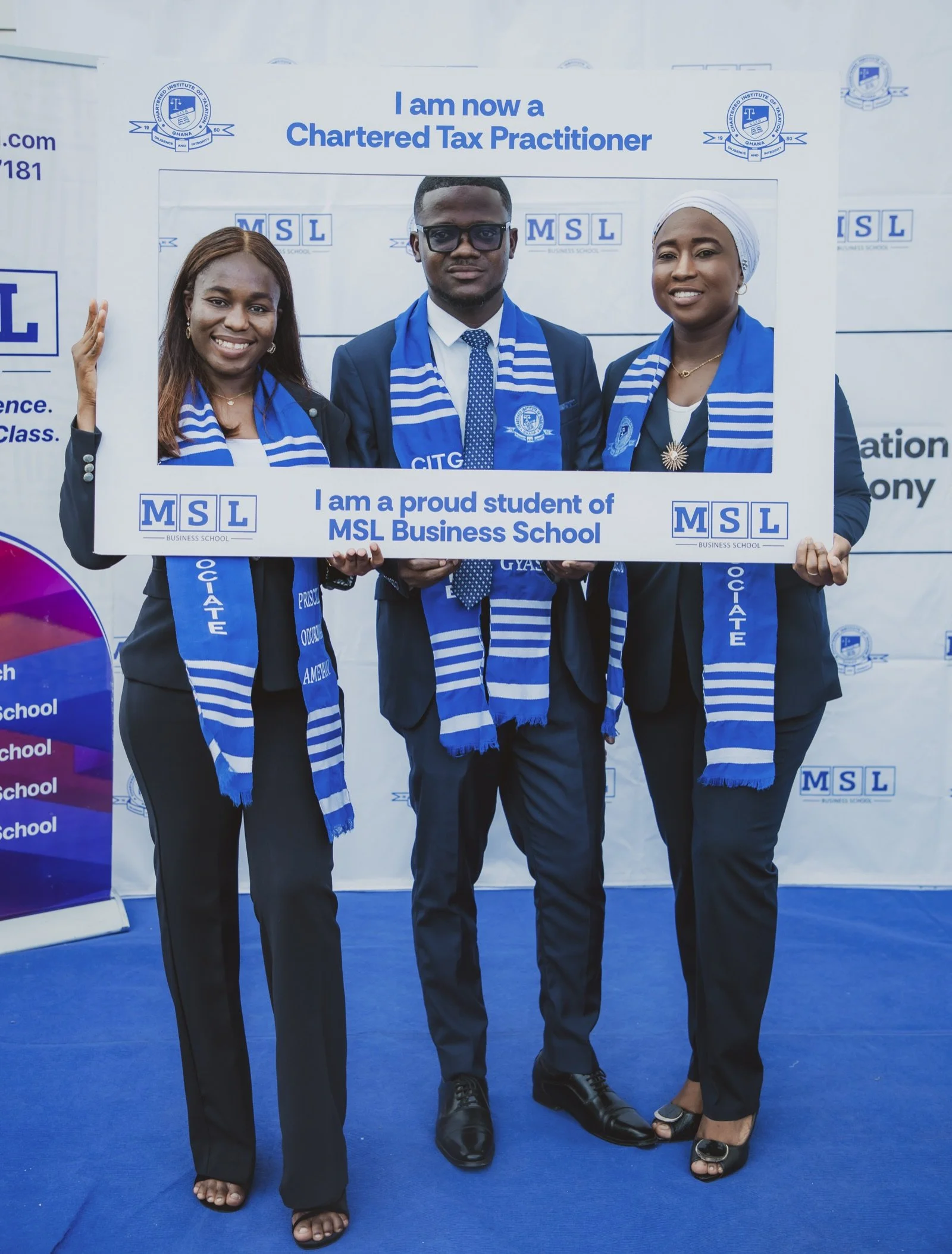
Across four consecutive years, MSL students have been named Ghana's National Overall Best Graduating Student at CITG. That record sits within 46 national academic awards earned across MSL programs.
Becoming a Chartered Tax Practitioner requires more than remembering tax rules. It requires precise statutory interpretation, sound professional judgement and the ability to communicate defensible advice under examination pressure. That discipline defines the MSL difference.
MSL delivers its CITG program fully online through structured live sessions, guided revision systems and continuous academic engagement. The model enables disciplined preparation, national accessibility and a consistent academic standard for candidates across Ghana and beyond.
That discipline is the MSL difference.
03 · The method
A system built for measurable CITG results.
Professional taxation examinations reward candidates who interpret legislation accurately, identify the issue, structure advice clearly and apply the law to the facts. MSL preparation is aligned to those examiner expectations from the beginning.
Comprehensive coverage, revision timetables aligned to CITG sittings, scenario-based simulations and performance-focused feedback. This is structured exam preparation, not passive content delivery.
04 · The platform
Technology that extends preparation beyond the live class.
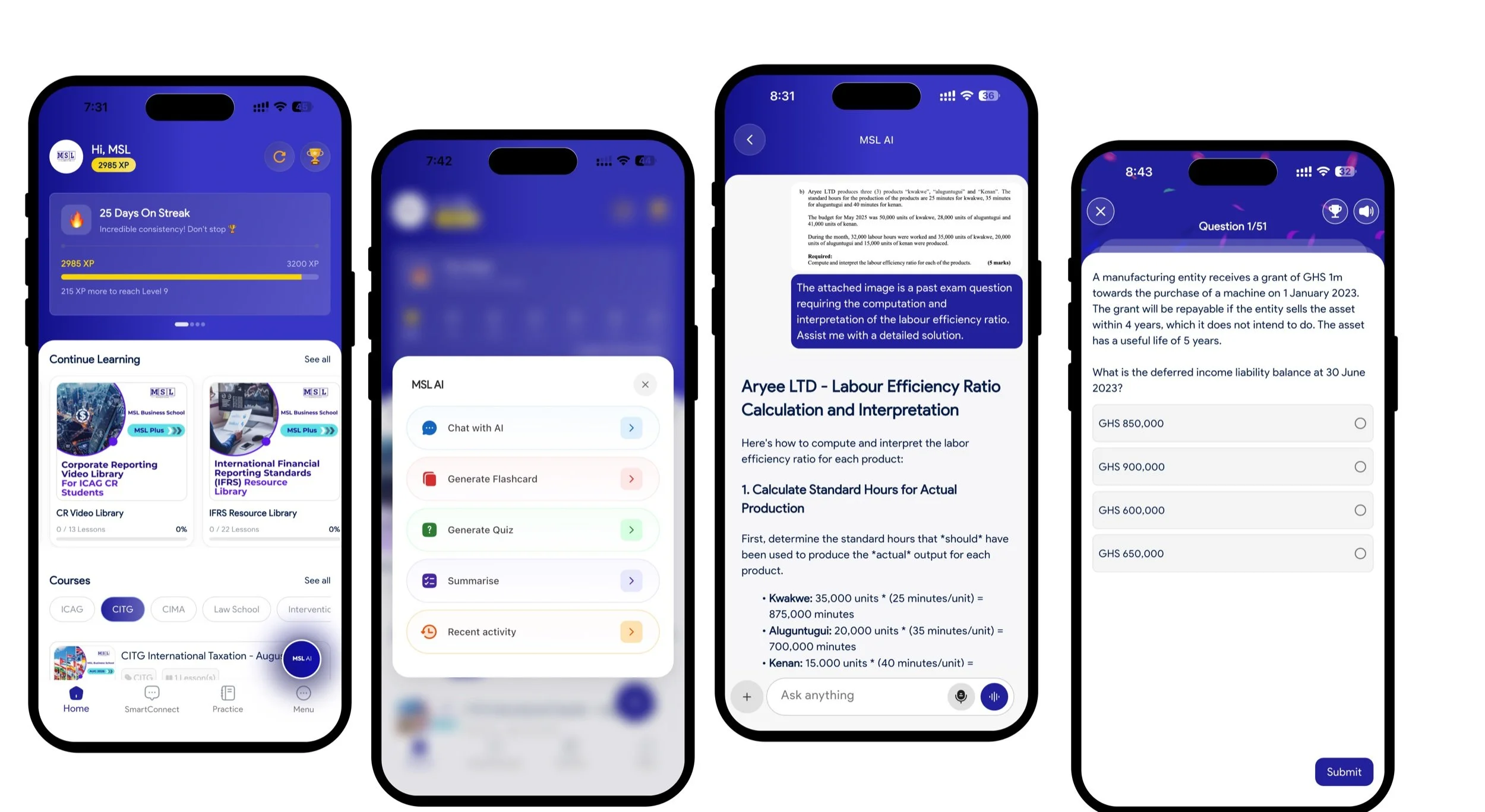
MSL Business School is Ghana's clear technology leader in professional education, the first and only provider with multimodal AI for CITG students. The MSL Business School App is a structured digital learning ecosystem that reinforces discipline and performance at every stage of preparation.
The platform
- Centralised course access across all CITG subjects offered by MSL
- Revision dashboards aligned with the CITG exam calendar
- Integrated practice questions and performance tracking
- Live class recordings and downloadable notes
- Multi-device access across Android, iOS and Windows
Embedded AI tools
- Intelligent topic summarisation
- Automated quiz and flashcard generation
- Text-to-speech reinforcement for audio revision
- Photo-based exam question solving
- Multimodal input, including text, voice and image
Technology at MSL is not decorative. It is built to improve examination outcomes.
Explore the MSL Business School App05 · The qualification
What is the CITG qualification?
The Chartered Institute of Taxation, Ghana is the statutory professional body that regulates the practice of taxation in Ghana under the Chartered Institute of Taxation, Ghana Act, 2016 (Act 916).
The CITG professional qualifying examination leads to the Chartered Tax Practitioner designation, the specialist professional credential for tax practice in Ghana.
The qualification contains 12 papers across three sequential levels: the Professional Level, Final Level 1 and Final Level 2. Candidates must also satisfy the Institute's practical experience and membership requirements before admission as Full Members.
MSL currently offers tuition for Final Level 1 and Final Level 2. Many MSL candidates are Chartered Accountants or lawyers who qualify for exemptions from the six Professional Level papers, subject to CITG's assessment and rules.
The 12 CITG papers at a glance
| Paper | Title | Level |
|---|---|---|
| 1 | Public Sector Economics & Finance | Professional Level |
| 2 | Income Taxation | Professional Level |
| 3 | Accounting & Finance | Professional Level |
| 4 | Indirect Taxation | Professional Level |
| 5 | Revenue & Business Law | Professional Level |
| 6 | Strategy & Governance | Professional Level |
| 7 | Tax Audit & Investigations | Final Level 1 |
| 8 | Oil, Gas & Other Minerals Taxation | Final Level 1 |
| 9 | International Taxation | Final Level 1 |
| 10 | Strategic Tax Planning | Final Level 2 |
| 11 | Advanced Taxation Practice | Final Level 2 |
| 12 | Tax Practice Administration & Ethics | Final Level 2 |
06 · The pathway
The qualification, level by level.
Each stage develops a different depth of professional competence and must be completed before progression to the next level.
Professional Level
Six papers covering the economic, legal, accounting and taxation foundations of professional tax practice. MSL does not currently offer tuition at this level. Many MSL candidates are Chartered Accountants or lawyers who receive exemptions, subject to CITG assessment.
Final Level 1
Three specialist papers: Tax Audit & Investigations, Oil, Gas & Other Minerals Taxation, and International Taxation. Candidates must complete this level before progressing to Final Level 2. Tuition at MSL is GHS 550 per paper.
Explore Final Level 1 →Final Level 2
The terminal level: Strategic Tax Planning, Advanced Taxation Practice, and Tax Practice Administration & Ethics. First-time candidates must attempt all three papers in one sitting. Any passes are carried forward. Tuition at MSL is GHS 600 per paper.
Explore Final Level 2 →07 · Timeline
How long does the CITG qualification take?
CITG holds examination sittings approximately twice a year, with windows in February and August.
Completion time depends on exemptions, the number of papers attempted and first-time pass rates. Chartered Accountants who are exempt from the Professional Level can begin at Final Level 1 and may complete the examination pathway in as few as two to three sittings.
Candidates completing all three levels usually require a longer pathway. With consistent first-time passes, the full examination route typically takes three to five years, in addition to the practical experience requirement for Full Membership.
At Final Level 2, a first-time candidate must attempt all three papers in the same sitting. Preparation quality therefore becomes decisive: MSL's system is designed to build readiness across all three papers together.

Career range
Technical authority with room to advise and lead.
The Chartered Tax Practitioner designation is the specialist professional credential for tax practice in Ghana.
CITG-qualified professionals work in tax advisory and compliance at professional services firms; independent tax consultancy; tax management and planning at multinationals, listed companies and financial institutions; taxation roles at the Ghana Revenue Authority; specialist advisory in oil, gas and mining; international tax for cross-border operations; and public sector taxation in ministries and regulatory bodies.
For Chartered Accountants who already hold the ICAG CA qualification, adding CITG creates a powerful combination of accounting and specialist taxation competence. Eligible professional qualifications may also shorten the route through exemptions assessed by CITG.
As Ghana's tax legislation and international obligations evolve, organisations need professionals who can interpret the law, quantify its effect and communicate defensible advice. The CITG qualification is built for that responsibility.
09 · Why the provider matters
Examination preparation should produce evidence.
CITG examinations test technical knowledge, statutory interpretation, application under time pressure, answer structure and professional communication. Covering content is not enough; candidates must learn to apply it the way CITG examiners assess it.

At MSL, CITG preparation is built around examiner expectations from day one. Every live session, revision cycle and simulation develops the statutory interpretation, answer structure and advisory judgement required in the examination. The MSL Business School App extends that preparation through structured digital revision, performance tracking and AI-assisted learning.
The evidence is documented: MSL students have secured the CITG National Overall Best Graduating Student award across four consecutive years. That is the result of structured preparation, not chance.
For candidates serious about passing, particularly at Final Level 2 where all three papers must be attempted together on the first sitting, tuition quality is the single most controllable variable in the outcome.
Four consecutive years. Four different cohorts. Four MSL students named Ghana's National Overall Best Graduating Student at CITG, the highest national distinction in the qualification.
10 · Exams and logistics
CITG sittings, format and examination centres.
CITG holds examination sittings approximately twice a year, with windows in February and August. Exact dates and registration deadlines are announced by CITG through official communications. MSL provides enrolled students with reminders of key deadlines and examination dates.
All CITG examinations, at Professional Level, Final Level 1 and Final Level 2, are written, in-person examinations held at CITG-approved examination centres.
A first-time Final Level 2 candidate must attempt all three papers in the same sitting. Any passes are credited and carried forward. This makes simultaneous preparation across the three papers essential.
11 · Frequently asked questions
Clear answers before you begin.
How much does CITG tuition cost at MSL?+
MSL charges GHS 550 per paper at Final Level 1 and GHS 600 per paper at Final Level 2. MSL does not currently offer tuition for the Professional Level.
How many papers and levels are in the CITG qualification?+
The CITG qualification has 12 papers across three sequential levels: six at Professional Level, three at Final Level 1 and three at Final Level 2.
Does MSL offer tuition for the CITG Professional Level?+
MSL currently offers tuition for Final Level 1 and Final Level 2. Many MSL candidates are Chartered Accountants or lawyers who are exempt from the six Professional Level papers, subject to CITG's assessment.
How long does it take to qualify as a Chartered Tax Practitioner?+
Completion time depends on exemptions and first-time pass rates. Chartered Accountants who begin at Final Level 1 may complete the examinations in as few as two to three sittings. Candidates completing all three levels typically require three to five years, plus the practical experience requirement for Full Membership.
How many times a year can I sit CITG exams?+
CITG holds examination sittings approximately twice a year, with windows in February and August. Exact dates are announced through official CITG communications.
Are CITG exams online or in person?+
All CITG examinations are written, in-person examinations held at CITG-approved centres including Accra, Kumasi and Ho.
Can I get exemptions from CITG papers?+
Yes. Chartered Accountants holding ICAG, ACCA or CIMA qualifications, and members of the Ghana Bar Association, are typically exempt from the Professional Level. Other qualifications are assessed by CITG. Final Level 2 cannot be exempted.
Why must all three Final Level 2 papers be taken together?+
A candidate appearing at Final Level 2 for the first time must attempt all three papers in one sitting. Any passes achieved are credited and carried forward.
What makes MSL different for CITG tuition?+
MSL prepares candidates the way CITG marks: examiner-aligned teaching, scenario-based simulations and statutory-interpretation practice. The MSL Business School App adds multimodal AI support, performance tracking and structured digital revision.
Page last reviewed and updated , aligned to the current CITG professional qualifying syllabus.