
MSL Business School
Welcome to the first edition of The MSL Business School Newsletter.
We begin at home: the ICAG and CITG graduation ceremonies in pictures, the national honours our students earned, and the biggest upgrade in the MSL App’s history. There is also the AI training session that drew more than 300 participants nationwide, our maiden CIMA case-study cohort, and seven graduates telling their own stories, from the Ghana School of Law to ENI, PwC, and Georgia State University.
Then the desks look outward: the levy amendment and the 2026 VAT reform on the tax pages, a livelier half-year on the markets, Ghana’s readiness for the IFRS sustainability standards, and a closer look at IFRS 20. A puzzle waits at the back. Use the contents strip above, or the letters A to H, and go wherever you like.
Multimodal AI comes to the MSL App
West Africa’s first multimodal AI learning platform for professional exam students: the MSL App now listens, sees, and speaks. Inside, the ICAG and CITG graduation ceremonies in pictures, and the national honours our students carried home.
A half-year of recognition and reach
Multimodal AI comes to the MSL App
One of the biggest upgrades in the app’s history, and the first multimodal AI learning experience of its kind in Ghana’s professional education space. It makes the MSL App West Africa’s first multimodal AI learning platform for professional exam students.
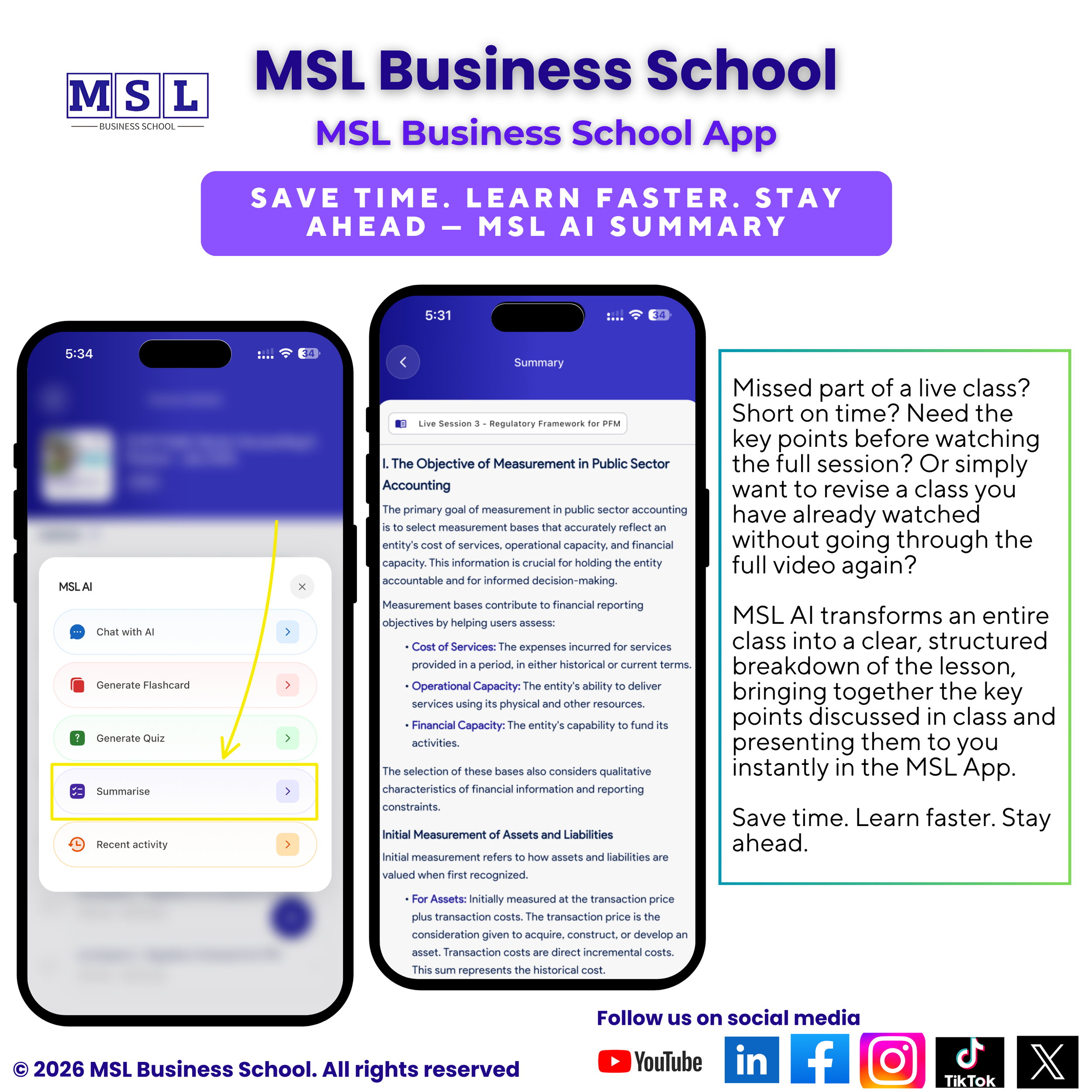
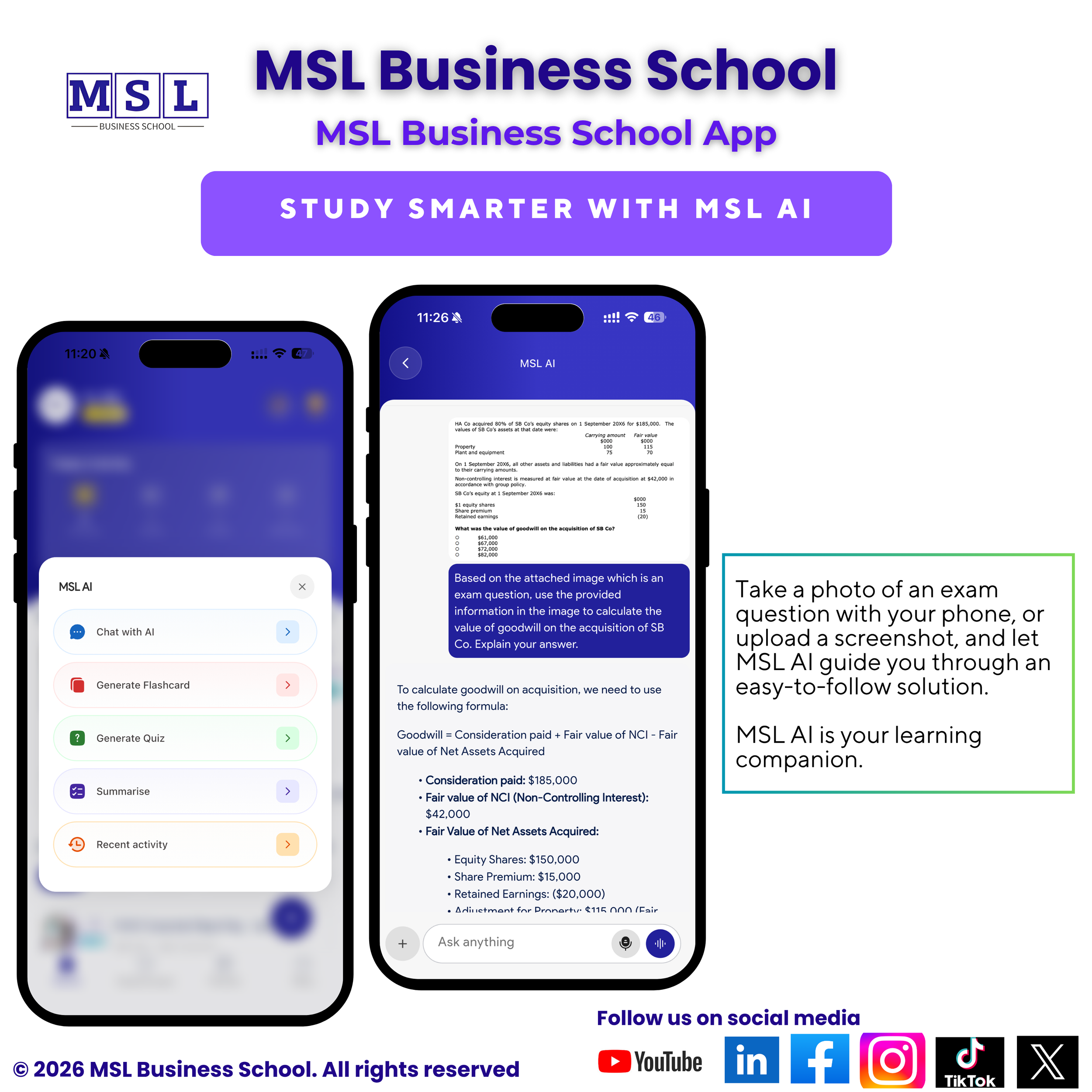
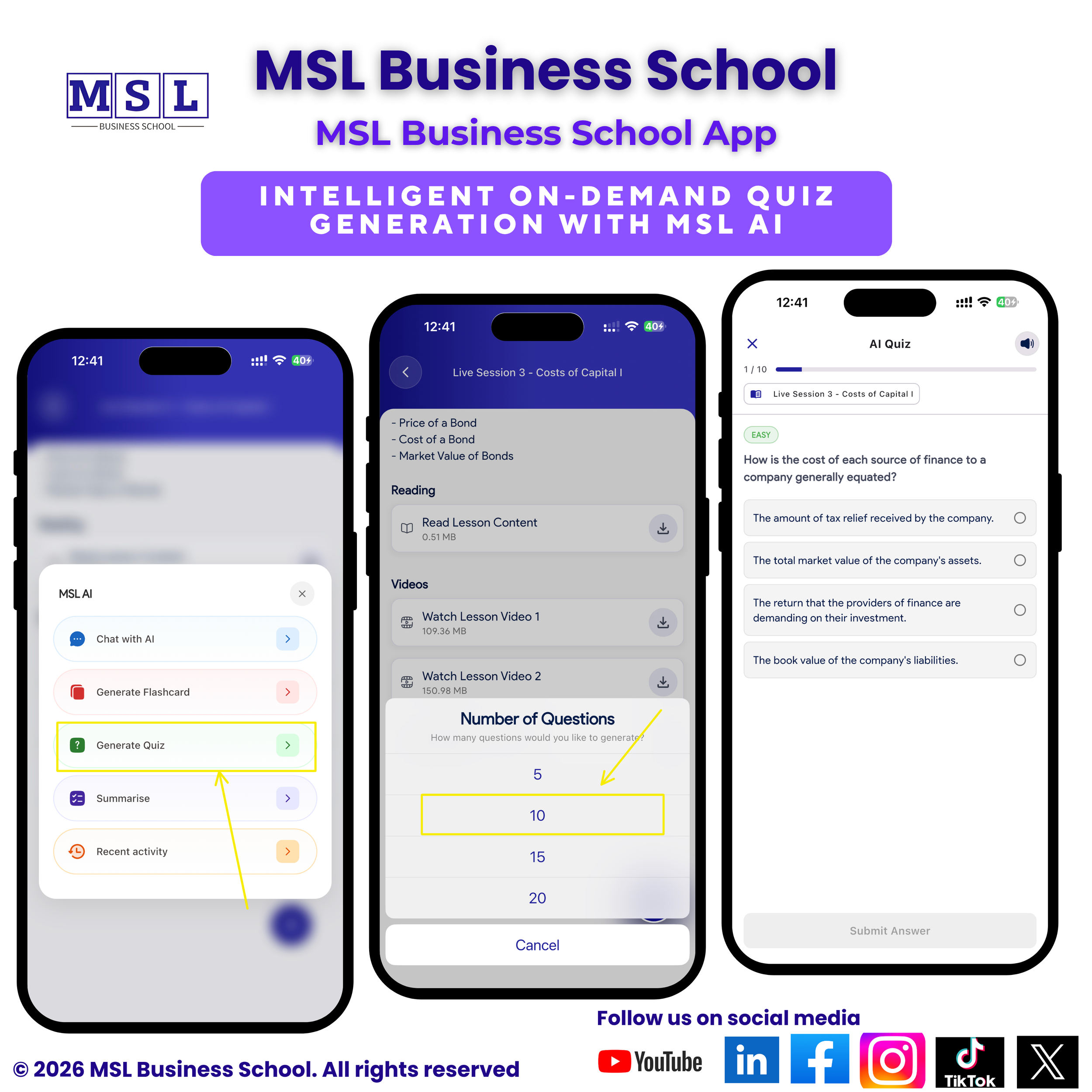
MSL has rolled out a major release of the MSL Business School App, with multimodal AI now built into the learning experience. Students can interact with MSL AI in three ways: text, voice, and images. Type a question, speak to MSL AI and get a response back in voice or text, or take a picture of an exam question and MSL AI will solve it and walk you through it. MSL AI is also up to 10 times faster than the 2025 rollout.
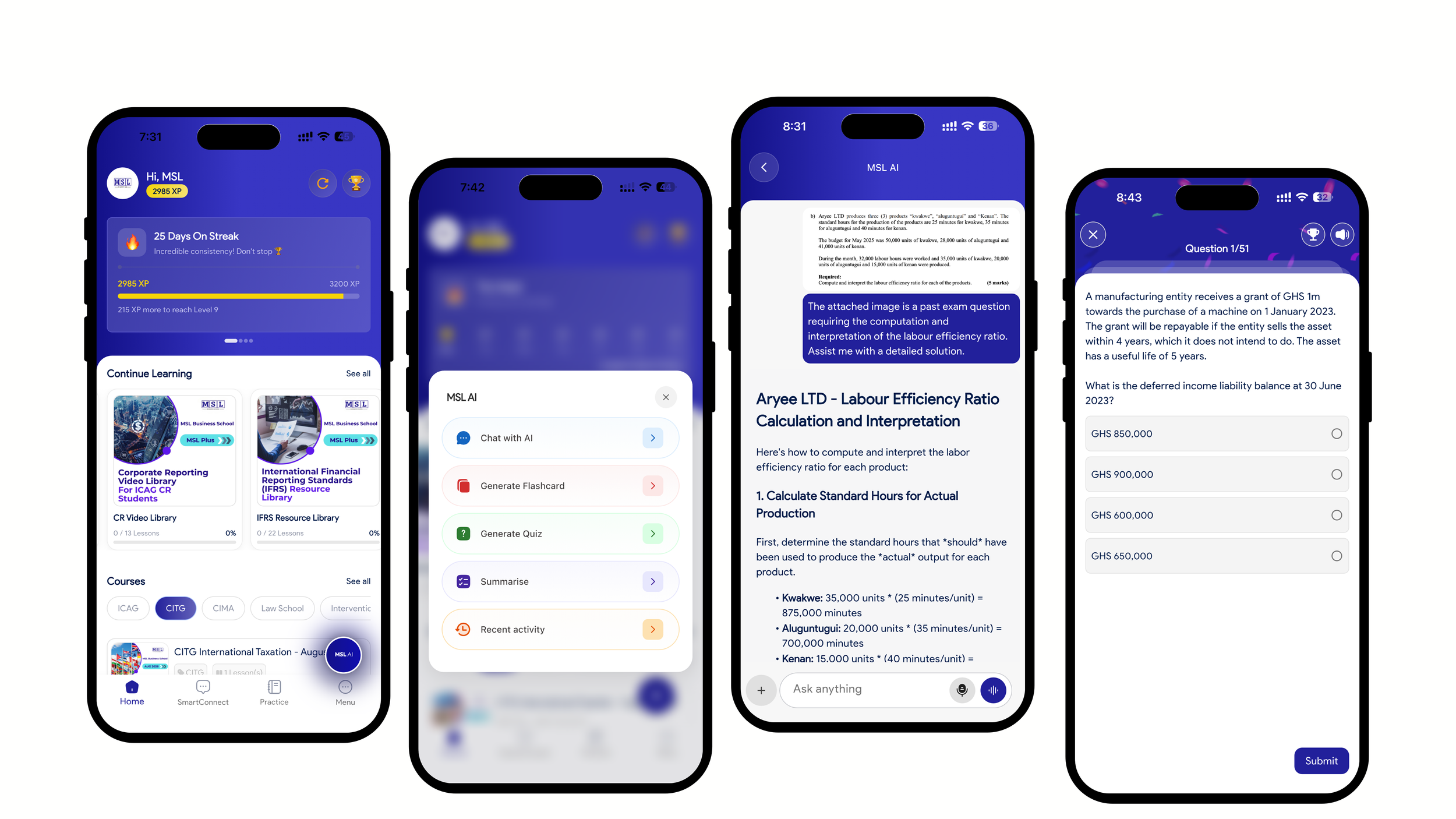
Also in this release
- Learning streaks, XP, and a leaderboard, so consistency is visible and effort counts.
- Quizzes and flashcards generated from topics across the app, plus quick lesson summaries.
- More relevant responses, with MSL AI remembering context within the conversation.
- A faster SmartConnect, MSL’s internal chat space, with message reactions built in.
“We are not trying to build just another tuition platform with videos and notes. We are building a serious learning platform for serious students. One that helps them understand better, practise better, and perform better. That has always been the standard. And we are still only getting started.”
Michael Siaw Larbi · Founder, MSL Business School
The MSL Business School App is free to download on Android, iOS, and Windows: mslbusinessschool.com/app.
ICAG Graduation & Admission Ceremony
ICAG celebrated the hundreds of students admitted into the profession, bringing together graduates, faculty, industry leaders, and government. Speakers emphasised professional ethics, continuous development, ESG reporting, and lifelong learning.
MSL achievement spotlight


CITG Graduation & Admission Ceremony
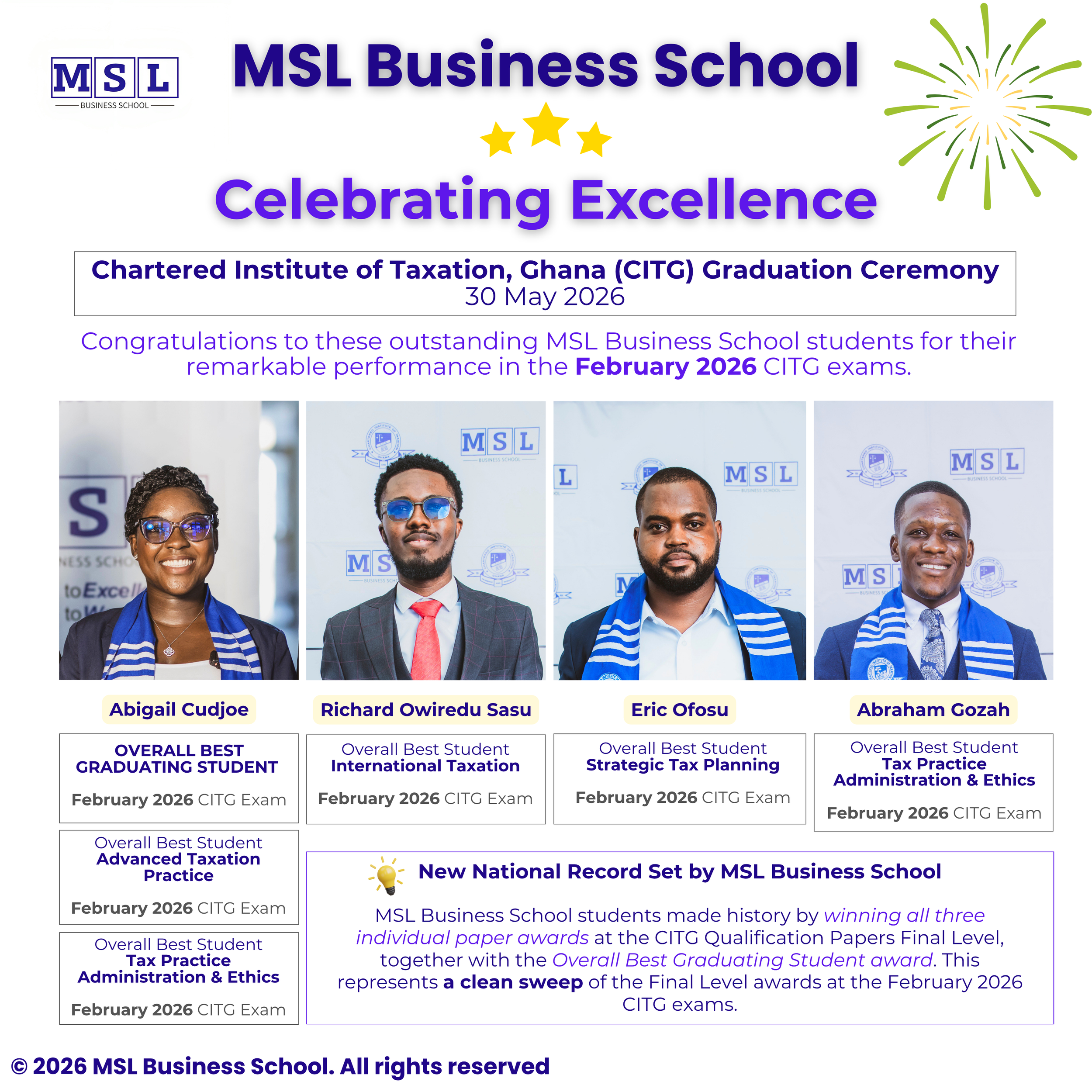
Six national awards for four students, among them the National Overall Best Graduating Student, and a clean sweep of the qualification’s final level.
Four students of MSL Business School received six national awards at the Chartered Institute of Taxation, Ghana graduation on Saturday, 30 May 2026, including the National Overall Best Graduating Student, the highest distinction the Institute confers. Held at the University of Professional Studies, Accra, the ceremony recognised results from the February 2026 examination sitting and took the school’s documented record to 46 national awards across ICAG and CITG since February 2023.
The honour roll
The headline record
Abigail Cudjoe is now the National Overall Best Graduating Student in both ICAG and CITG. Having taken the national title in ICAG at the March 2024 examination, she becomes the first MSL Business School student to hold the highest graduating award in both professional qualifications, and the first to win three national awards in a single sitting on two separate occasions.
The sitting yielded more than individual honours. In Tax Practice Administration & Ethics, the two leading results in the country both belonged to MSL students: Gozah and Cudjoe tied at the highest national mark, giving the school both halves of a single joint award. And across the three subjects examined at CITG’s final level, every Overall Best award went to an MSL candidate: a clean sweep of the final level, alongside the national best overall.
It was also the thirteenth consecutive examination diet at which MSL students have taken national awards across ICAG and CITG, and the school’s seventh straight CITG sitting with national winners.
“I am deeply proud of Abigail, Eric, Abraham and Richard, and of every MSL student who graduated in Accra this weekend. Results like these belong first to the students and the work they put in. Our part is to set a high standard and give them tools built for the way they are examined; the achievement is theirs. We are grateful to the Chartered Institute of Taxation, Ghana, for recognising their effort.”
Michael Siaw Larbi · Founder, MSL Business School


Hundreds of students graduated on the day; these photographs show just a few of them. MSL Business School’s graduating class and award winners at the 2026 CITG graduation. University of Professional Studies, Accra, 30 May 2026. Tap any photograph to view it in full.
The role of MSL AI
MSL AI provides personalised pathways, intelligent practice questions and simulations aligned to exam standards, instant feedback, and simplified explanations – helping students study efficiently, find gaps early, and build confidence.
MSL AI & Technology training
MSL hosted a special session on Saturday, 14 March 2026, introducing students and professionals to the growing role of AI in accounting, finance, and business operations. The session began at 9am and was facilitated by MSL founder Michael Siaw Larbi.
An accelerated path to CIMA membership for degree holders
MSL Business School and AICPA & CIMA hosted an online session on the fastest route to the Chartered Global Management Accountant designation for first-degree and master’s holders: a digital pathway that replaces most of the exam hall with continuous online assessment.
The joint session, held on the evening of 7 June 2026, was led by MSL founder Michael Siaw Larbi, himself a CGMA, with Paul Aninakwah, Country Director for AICPA & CIMA across Ghana, Côte d’Ivoire, Liberia, Senegal and Sierra Leone. CIMA has trained management accountants for more than a century, and in 2015 joined with the American Institute of CPAs to form AICPA & CIMA, a body of around 700,000 members, candidates and registrants in roughly 150 countries.
Fewer exam halls, the same qualification
The qualification has four levels: Foundational, Operational, Management and Strategic. On the traditional route, a student sits every subject in an examination centre, up to fifteen visits in all. On the CGMA Finance Leadership Programme (FLP), the body’s digital pathway, the subjects at each level are studied and assessed online, and the only examination taken in a centre is the case study that closes each level: as few as three visits for the same syllabus. The case studies run four times a year, in February, May, August and November, and AICPA & CIMA told attendees that a committed student, studying around five to seven hours a week, can complete the qualification in roughly a year.
The programme is sold as a single package: one fee covers registration, access to all four levels of the platform, and every assessment, with no separate charge for textbooks. Graduates of partner universities in the region qualify for discounted rates arranged through the AICPA & CIMA office.
The headline
A finance or MBA graduate can reach the CGMA designation by sitting two case studies. A chartered accountant, just one. Accounting and finance graduates, and MBA holders, enter at the Management level and sit the Management and Strategic Case Studies. Members of ICAG enter at the top and sit a single paper, the Strategic Case Study. Other backgrounds have their entry point confirmed by AICPA & CIMA once qualifications are assessed.
MSL’s role: coaching for the case studies
MSL provides tuition for the case studies, the stage most candidates find hardest, delivered live and fully online. The Strategic Case Study programme for chartered accountants is already running: its first cohort sat the examination in May 2026, and the next sits in August. A Management Case Study class follows for the November sitting. Students are supported by the MSLApp AI tutor, trained across the CGMA syllabus from the Operational to the Strategic level: photograph a question from the FLP platform and have it explained step by step, generate practice quizzes, and revise on demand.
“For a graduate who wants a global qualification without years in the exam hall, this is one of the most efficient routes available. Our part is the piece that still needs a teacher: the case studies. We give students live coaching and an AI tutor trained across the whole syllabus, so the digital pathway never has to feel like a solo effort.”
Michael Siaw Larbi · Founder, MSL Business School
Fees, exemptions and entry points are set by AICPA & CIMA and confirmed on application. A recording of the session is available on the MSL Business School YouTube channel. Explore CIMA tuition at mslbusinessschool.com/cima.
Where our students are now
Real journeys from the MSL community, in their own words. Seven profiles, told in full.

Rachel Dankyi
I enrolled with MSL Business School for the CITG programme, the Chartered Institute of Taxation, Ghana qualification. I particularly appreciated that the lecturer was not only passionate about building a successful institution, but also deeply committed to ensuring that each student truly understood the tax concepts and principles being taught.
Stay committed to the process. You may not always be able to perfectly balance lectures and everything else, but it is important to know when to prioritize and remain focused on your goal.

Graham Melomey
I started my ICAG journey with MSL in March 2025 through the Future Leaders Scholarship Program. With their guidance and support, I cleared my remaining six papers across the July and November 2025 sittings. Along the way, I was privileged to score the highest marks in Ghana in Public Sector Accounting and Finance and in Financial Management through MSL Business School, receiving Overall Best Student awards from ICAG at the July 2025 examinations. Honestly, I consider MSL one of the best places to study professional accounting in Ghana. From high school through university, I have never experienced such a smooth blend of technology and truly impactful teaching.
Always stay connected to the reason why you started this journey. Keep that purpose close, prepare thoroughly for each paper, and success will surely follow.

Thelma Amankwanua Ashley
I began my CITG journey through self-tutoring and joined MSL Business School at Final Level 2 while at the Ghana School of Law. The lessons, support, materials, and community played a key role in my success.
As someone from a general arts background, my advice is to believe you are capable of not just passing your exams but becoming sought after in your tax practice. The MSL platform prepares your mind for practice, not just for passing exams.

Gifty Koufie
My journey with MSL Business School began in November 2024 when I started preparing for my Level 3 papers. I was introduced to MSL by friends who had successfully completed their exams, and I decided to give it a try. Looking back, it was one of the best decisions I made. I particularly appreciated the use of technology in teaching and the patience and dedication of the tutors, which made the learning experience very effective. I would confidently recommend MSL Business School to anyone preparing for professional exams.
Take ownership of your journey. Stay consistent and take your classes seriously: there is so much you can learn when you remain committed. Do not be discouraged by setbacks; keep pushing until you achieve your goals.

Atta Acheampong
I joined MSL Business School to prepare for Final Level 2 of my CITG exams following strong recommendations from friends, and it turned out to be one of the best decisions I have made. I passed all three papers in a single sitting, made possible by the high-quality, practical tuition I received: my tutor handled all three subjects and made even complex topics easy to understand. The user-friendly learning platform, with lecture videos and notes readily accessible, made my studies flexible, smooth, and highly effective.
Stay determined, disciplined, consistent, and resilient. Embrace group studies where possible: studying with others deepens understanding, exposes you to different perspectives, and keeps you motivated. Your efforts will surely pay off.

Edith Skuggen
My journey at MSL Business School was both challenging and deeply rewarding. Juggling work, studies, and the responsibilities of being a new mother was not easy, but the school’s learning approach, and Michael’s guidance, kept me focused and motivated. By the grace of God, I passed all my Level 3 papers on my first attempt, even while holding exemptions.
Follow your tutors’ recommendations closely, stay attentive in class, and rewatch the lecture videos until the material is fully understood. Start preparing early, maintain discipline, and remain committed throughout the process.

Anthony Kofi Mensah
My ICAG journey began at MSL Business School, an experience that proved both rigorous and highly rewarding. Through discipline, consistency, and the support of dedicated tutors, I progressed through the levels in a relatively short period. The MSL App let me revisit previously taught courses at any time, and the study materials stayed up to date and aligned with current standards. MSL’s fees were highly competitive without compromising quality. Without hesitation, I consider MSL among the leading institutions in the country.
Remain consistent, stay disciplined, and make deliberate use of past questions and available resources. Success in ICAG requires focus and persistence, and MSL provides the right environment to achieve it.
TaxLawGH launches the Ghana Tax Calculator
In March 2026, TaxLawGH, the tax and fiscal policy education unit of MSL Business School, released a free tool for the calculations practitioners work through every day.
The Ghana Tax Calculator brings the routine arithmetic of Ghanaian tax practice into one place: withholding tax, VAT and the levies, PAYE, and penalties and interest, alongside a tracker for key filing deadlines. If you have ever worked through these by hand, or stopped to double-check a rate against the law, it should make things easier.
This is Version 1, and it will keep improving and expanding over time. It is free to try at taxlawgh.com/ghana-tax-calculator.
Ghana’s Growth and Sustainability Levy amendment
Parliament has cut the levy on mining production from 3% to 1%, easing the burden on producers while government weighs the trade-off against sustainability funding.
Mining, gold in particular, remains a pillar of Ghana’s economy. In 2025 the Minerals and Mining Royalties Regulation tied royalties to the gold price: above $1,900 an ounce, producers pay 5%. On 13 March 2026, Parliament reduced the Growth and Sustainability Levy from 3% of gross production to 1%.
For accountants advising the sector, the change feeds into tax-planning strategy, forecasting, and investment decisions. Some stakeholders caution that a lower levy could reduce funding for environmental programmes – the standing tension between competitiveness and sustainability.
Ghana’s VAT reform 2026
The Value Added Tax Act, 2025 (Act 1151), with amendments to NHIL and GETFund, reshapes Ghana’s indirect-tax system – streamlining rates, widening the base, tightening compliance.
The reform, area by area
The key changes in each area, in brief.
- The cascading impact of the GETFund Levy (2.5%), NHIL (2.5%), and Tourism Levy is abolished for taxable supplies.
- GETFund Levy and NHIL are now deductible as input VAT.
- The cascading effect still applies to imports.
- The taxable base is unified across VAT, NHIL, and GETFund Levy.
- The COVID-19 Levy is abolished; cascading still persists for the CST and Excise Duty.
- A unified VAT rate of 15% applies to all taxable supplies, replacing the previous 3% and 5% flat rates.
- NHIL and GETFund Levy remain at 2.5% each.
- Taxable activities expand to natural-resource exploration and non-traditional exports (excluding cocoa, coffee, shea butter).
Services
- Registration is mandatory; the turnover threshold is abolished except where the Commissioner-General grants an exemption.
Goods
- Threshold raised from GHS 200,000 to GHS 750,000 annual turnover.
Public entertainment
- Promoters register at least 48 hours before an event; the GHS 10,000 threshold is removed.
- Failure to register: minimum three times the unpaid tax (was a maximum of two times).
- Unregistered importers: upfront penalty raised from 12.5% to 20% of customs value.
- Tax evasion: fine of two to three times the tax evaded, plus two to five years’ imprisonment.
- A targeted VAT refund scheme replaces automatic relief for Third Schedule entities.
- A taxpayer reward scheme based on invoice numbers encourages proper invoicing.
- Fiscal Electronic Devices become mandatory in selected sectors from 2026, with electronic return filing.
Sector spotlight
How five key sectors are affected.
- VAT relief now applies to reconnaissance and prospecting goods and services, for licensed entities.
- Zero-rating expands to export freight, export-related insurance, stevedoring, port operations, and transit shipping-line charges.
- Zero-rating extended for locally manufactured textiles to 31 December 2028, subject to ministerial approval.
- Excess input-VAT refunds for textile and sanitary-towel makers.
- Zero-rating for locally assembled vehicles is abolished.
- No longer exempt supplies.
- Operators must determine whether services are standard-rated or otherwise taxable.
- Management fees for private equity, venture capital, and mutual funds are no longer exempt.
- Digital services widen to include virtual and digital-asset management.
Try the arithmetic
VAT calculator · under Act 1151
InteractiveIllustrative, computed on a unified base per Act 1151 (VAT 15%, NHIL 2.5%, GETFund 2.5%). NHIL and GETFund are now deductible as input VAT for registered businesses.
GRA unveils ITAS
The Integrated Tax Administration System consolidates fragmented legacy platforms into one digital system – a step toward faster, more transparent revenue collection.
ITAS modernises how taxes are administered, processed, and monitored. For taxpayers that means fewer hurdles and quicker turnaround; for the GRA, a stronger basis for monitoring compliance and managing data. Roll-out begins with a pilot at selected offices before scaling nationwide, with success hinging on staff training and adoption.
Reforming non-tax revenue
The Ministry of Finance has opened stakeholder talks on reforming Non-Tax Revenue – the fees, levies, dividends, and charges that increasingly complement taxation.
Current practice has evolved unevenly, producing inconsistent pricing, reporting, and accountability. The reform proposes a coordinated system built on a Strategic Framework and an overarching legal structure, supported by the African Development Bank.
Two-month amnesty for uncustomed vehicles
The GRA has opened a penalty-free window for users of uncustomed vehicles to regularise their status before stricter enforcement resumes.
Capital markets, rates, and the economy
New listings on the Accra bourse, two rate cuts and a hold, inflation cooling then stirring, and a milestone in the IMF programme: the half-year in Ghana’s markets.
Ghana’s capital market showed renewed energy in the first half of 2026, with new listings, stronger investor demand, and an improving macroeconomic backdrop giving the market a more positive tone.
The IPOs return
The IPO market was one of the clearest signs of the shift. ZEN Petroleum listed on the Ghana Stock Exchange on 22 April 2026 under the ticker ZEN, after an offer of 128 million shares at GHS 5.00 per share. The offer raised GHS 640 million, with reported bids exceeding GHS 970 million: strong investor appetite for the indigenous downstream petroleum company.
Kasapreko followed with one of the most closely watched consumer-sector listings in years. The beverage maker’s offer opened on 4 May and closed on 1 June 2026: 583.3 million new ordinary shares at GHS 1.20 per share, targeting up to GHS 700 million. The offer was oversubscribed by about 146 percent, with demand reaching roughly two and a half times the offer size, and the shares listed on 15 June under the ticker KASA.
Both followed First Atlantic Bank, which debuted on 19 December 2025 after a largely oversubscribed offer of up to 101.7 million shares at GHS 7.30 each, combining new and existing shares: the exchange’s first equities IPO since 2018.
Rates: two cuts, then a hold
The May decision came with that important liquidity adjustment: even though the policy rate was unchanged, the reserve amendment still shifted monetary and liquidity conditions for banks and the wider financial system.
Prices, growth, and the cedi
Inflation remained one of the defining stories of the period. The Ghana Statistical Service reported year-on-year inflation of 5.3% in June 2026, up 1.6 percentage points from May’s 3.7% and the third consecutive monthly rise, driven mainly by non-food prices. The reading confirmed both sides of the story: inflation has fallen dramatically from 13.7% a year earlier, but price pressures have not fully disappeared.
Growth was also strong: the Statistical Service reported real GDP growth of 6.4% for the first quarter of 2026. On the currency, the Bank of Ghana reported the cedi had depreciated by 8.4% against the US dollar as of 15 May 2026, largely on energy-sector demand and corporate dividend payments, while gross international reserves rose to US$14.4 billion, equivalent to 5.7 months of import cover, from US$13.8 billion at the end of 2025.
Debt and the programme
In February, Government paid GHS 10 billion in interest under the Domestic Debt Exchange Programme: the sixth coupon settlement, and the second full cash payment without any Payment-In-Kind component, which the Ministry of Finance said reflects strengthened fiscal capacity and solvency.
The broader market remained heavily fixed-income driven. The Ghana Fixed Income Market traded GHS 35.05 billion in April 2026, up more than 93 percent from GHS 18.12 billion a year earlier, with Treasury bills dominating activity, government notes and bonds taking most of the remainder, and corporate bonds about one percent of volume.
And in May, IMF staff completed the 2026 Article IV consultation and reached staff-level agreement with Ghana on the sixth and final review under the Extended Credit Facility, alongside a request for a 36-month Policy Coordination Instrument. The Fund cited substantial stabilisation gains: rapid disinflation, rebuilt international reserves, improved confidence in the cedi, stronger fiscal performance, and a sharp decline in the public debt ratio.
The world in brief
- Global mergers and acquisitions reached US$2.8 trillion in the first half of 2026, up 48% year on year and the strongest opening half on record, per LSEG data. Forty-seven deals above US$10 billion contributed more than US$1.3 trillion, while the number of deals fell 9% to about 24,000, a six-year low.
- The US Federal Reserve held its target range at 3.50% to 3.75% in June.
- The European Central Bank raised its three key rates by 25 basis points on 11 June, its first increase since 2023, taking the deposit facility to 2.25%, main refinancing to 2.40%, and the marginal lending facility to 2.65%, effective 17 June 2026.
- The Bank of England held Bank Rate at 3.75% in June, with two of nine Monetary Policy Committee members voting for an increase to 4.00%.
Taken together, the half-year read as recovery, reopening, and caution: improving stability and renewed market activity at home, and a more active but watchful world, still shaped by inflation risk and the weight of central-bank decisions.
IFRS 20: a new model for rate-regulated entities
On 27 May 2026 the IASB issued IFRS 20 Regulatory Assets and Regulatory Liabilities – the first comprehensive model for entities whose prices are set by a regulator, common in electricity, water, and gas.
In plain terms, IFRS 20 makes financial statements reflect not only what a company billed customers this period, but also the regulatory rights and obligations that will shape future rates. It closes a long-standing gap that left similar regulated businesses reporting inconsistently.
The core idea: a difference in timing
A regulated company may supply a service in one period but only be allowed to recover the cost through rates in a later period – or charge now and refund later through reduced rates. Where those timing differences create enforceable rights or obligations, IFRS 20 recognises regulatory assets and liabilities, with matching regulatory income and expense. Use the toggle to compare the two.
Worked example: the regulatory asset
Worked example: the regulatory liability
What else to know
The standard, area by area.
- Applies to entities under a regulatory agreement that creates regulatory assets and liabilities, setting how a regulator determines the rates charged to customers.
- Most relevant to utilities, energy, and other essential services.
- Does not apply to regulated premiums in insurance contracts within IFRS 17.
- IFRS 20 introduces regulatory income and regulatory expense, so timing no longer distorts profit.
- Without it, an entity can look less profitable when costs precede recovery, or more profitable when amounts must later be returned.
- A cash-flow-based technique: estimate the future cash flows, then discount them at the applicable regulatory interest rate.
- It weighs the amount, the timing, the uncertainty, and the time value of money – demanding judgement, reliable data, and documentation.
- Entities disclose regulatory assets, liabilities, income, and expense.
- Disclosures explain how balances arose, when they will be recovered or fulfilled, and the related risks – helping users judge the amount, timing, and uncertainty of future cash flows.
- Can move key measures: profit or loss, total assets and liabilities, gearing ratios, and return on assets.
- Implementation may need data not currently captured in IFRS-ready form, so scoping should start early.
- Confirm whether the entity is within the scope of IFRS 20.
- Identify which regulatory arrangements may create timing differences.
- Assess whether regulatory assets or liabilities may arise.
- Determine what data is needed to measure those balances.
- Plan how systems will track future recovery or reversal.
- Model the impact on profit or loss, assets, liabilities, and key metrics.
Read the complete IFRS 20 explainer, with worked examples and a full FAQ, on the MSL Insights desk.
IFRS adoption and the move to sustainability reporting
Ghana continues to apply IFRS as the foundation for corporate reporting – keeping statements transparent, comparable, and credible to international investors.
Building on that, ICAG is moving the market toward IFRS S1 and S2, the ISSB’s Sustainability Disclosure Standards. The ISSB issued both on 26 June 2023, effective for periods beginning on or after 1 January 2024, and the Council of ICAG approved a phased Ghana roadmap on 28 March 2024. Entities will disclose sustainability-related risks and opportunities in the same report and at the same time as their financial statements, strengthening ESG accountability.
Ghana’s three-phase sustainability roadmap
A structured, phased pathway balancing readiness against high-quality reporting.
- Applies to entities that choose to adopt early.
- Covers periods from 1 January 2024 to 31 December 2026.
- Early adopters complete a readiness assessment by 30 August 2024.
Significant Public Interest Entities and regulated non-listed entities, including:
- Listed entities; regulated banks, insurers, corporate trustees, and registered pension schemes.
- Public limited companies and holding companies of public or regulated entities.
- Oil & gas, mining, refineries, automobile and cement producers, and non-renewable power generators.
Other Mandatory Adopters: all remaining companies under Act 992 except SPIEs, government organisations (other than SOEs using IFRS), and non-mandatory companies.
- Entities using IPSAS follow a later date.
- ICAG sets timing once the IPSASB issues public-sector sustainability standards.
- No public accountability.
- No public trading or issuance of securities.
- Do not hold assets in a fiduciary capacity for a wide group.
- Revenue of GHS 50 million or less over the last two years.
- Total assets of GHS 40 million or less in the preceding year.
Reporting requirements
Sustainability information sits in the annual report, after the directors’ report but before the auditor’s report, signed by two directors and the Chief Sustainability Officer. Disclosures cover the same period and are issued at the same time as the financial statements, with comparatives, unless transition relief applies. Assurance is not required in the first year of adoption but becomes mandatory from the second year, by an independent provider approved by the Council of ICAG.
How ready is Ghana? Explore the index
A joint ICAG and WACAR study scored Ghana’s readiness for IFRS S1 and S2 across four pillars. Here is how each pillar scored.
Only 29.5% assess environmental risks across time horizons and just 19.9% have a climate transition plan. Sustainability is not yet embedded in strategic decision-making.
Only 36.5% have clearly defined oversight roles and 21.6% link sustainability KPIs to executive pay, and just 19.1% report adequate staffing to implement the standards. Governance is weighted most heavily in the index.
28.6% manage physical climate risks and 26.1% manage transition risks. Organisations are not yet ready for IFRS S2 climate-risk disclosure.
The weakest pillar. Only 18.7% have GHG-reduction targets and 16 to 17% track Scope 1, 2, or 3 emissions. Data and measurement frameworks are missing.
What the study found
Awareness is high, depth is thin. 89.2% are aware of IFRS S1 and S2 and over 85% grasp their purpose, yet only 55.6% can identify specific S2 requirements.
Practice is nascent. Only 18.7% have senior sustainability leadership, 15.8% publish reports, and 14.1% obtain external assurance.
The verdict. Ghana is not starting from zero, but full compliance needs capacity building, regulatory guidance, and phased implementation – with governance, climate-risk management, and data systems the most urgent gaps.
IPSASB SRS 1: first public-sector climate standard
The IPSASB has released IPSASB SRS 1: Climate-related Disclosures – the first sustainability standard built specifically for the public sector.
Four pillars, mirroring IFRS S2
- Disclose how climate-oversight roles are assigned.
- Explain how oversight is carried out in practice.
- How climate matters influence strategy and decisions.
- Actual and potential financial effects.
- Scenario analysis and resilience assessment.
- Processes for identifying, assessing, prioritising, and monitoring climate risks and opportunities.
- GHG emissions across Scopes 1, 2, and 3 using the GHG Protocol or a justified alternative.
- Other indicators and the climate targets being tracked.
The riddle page
Five of the most famous riddles ever asked, from the Sphinx of Thebes to the fireside classics. Three clues each; reveal when you are ready.


Keep learning with MSL
Stay updated on upcoming programmes, professional insights, and academic opportunities from MSL Business School.
- The Bank of Ghana cut the Monetary Policy Rate from 18% to 15.5% on 28 January 2026, to 14.0% on 18 March 2026, and held it at 14.0% on 20 May 2026.
- Consumer inflation stood at 5.3% in June 2026, down from 13.7% a year earlier.
- Ghana’s economy grew 6.4% year on year in the first quarter of 2026.
- Gross international reserves reached US$14.4 billion, about 5.7 months of import cover.
- ZEN Petroleum raised GHS 640 million in April 2026 with bids above GHS 970 million; Kasapreko’s offer was oversubscribed by about 146%.
- Parliament cut the Growth and Sustainability Levy on mining production from 3% to 1% on 13 March 2026.
- The Value Added Tax Act, 2025 (Act 1151) unified Ghana’s VAT at a single 15% rate.
- IFRS 20, the IASB’s standard for rate-regulated activities, becomes effective on 1 January 2029.
- Students of MSL Business School received 5 national awards at the February 2026 ICAG ceremony and 6 at the May 2026 CITG ceremony.